
If Your CO Alarm Is Sounding RIGHT NOW
Do not investigate. Do not collect belongings. Follow these steps immediately:
- 1Get everyone out of the home immediately, including all pets.
- 2Do not stop to gather belongings, phones, shoes, or anything else.
- 3Leave a door open as you exit to help ventilate the space.
- 4Call 911 from outside the home or from a neighbor's house.
- 5Do not reenter under any circumstances until the fire department measures CO levels and officially clears the space.
TL;DR Summary
- 4 beeps, pause, 4 beeps repeating = CO detected. Evacuate now and call 911 from outside.
- 1 chirp per minute = low battery. Replace within 24 hours.
- 5 chirps per minute = end of life. Replace the entire detector immediately.
- CO does not rise or fall. It distributes evenly at breathing height. Mount detectors at 5 feet, not on the ceiling.
- If the alarm stopped on its own and anyone has symptoms (headache, dizziness, nausea), still call 911. CO may have just dissipated temporarily.
A professionally monitored CO detector reports this to a 24/7 monitoring center automatically. NetSecure360 is headquartered in Camp Hill, PA and offers these systems nationwide.
What Is Carbon Monoxide?
Carbon monoxide is a colorless, odorless, tasteless gas produced by the incomplete combustion of carbon-containing fuels. It is often called the silent killer because there is no sensory warning before it reaches dangerous concentrations.
Common household sources include gas furnaces, gas water heaters, gas stoves, attached garages with a car running, portable generators operated indoors or near windows, blocked chimney or flue vents, and wood-burning or gas fireplaces. Any fuel-burning appliance can produce CO if it is malfunctioning or improperly ventilated.
According to the CDC, approximately 400 Americans die each year from unintentional, non-fire-related CO poisoning. The NFPA refers to CO as the silent killer because its victims often have no warning before losing consciousness.
Carbon Monoxide Alarm Beeping: What Each Pattern Means
The UL 2034 standard defines the alarm patterns for CO detectors sold in the United States. The pattern your detector is making determines whether you need to leave immediately or simply replace a battery. Count the beeps carefully before assuming anything.
4 continuous beeps, pause, repeat = CO detected. Evacuate immediately.
This is the emergency signal. The electrochemical sensor has measured CO above safe threshold levels. Do not silence it. Do not reset it. Evacuate as described above and call 911.
1 chirp every 60 seconds = low battery. Replace within 24 hours.
A single short chirp approximately once per minute is a status alert, not an emergency. A detector on a dying battery may not have enough power to trigger the full 4-beep alarm if CO is actually present. Replace the battery promptly.
5 chirps per minute = end of life. Replace the entire unit.
Five chirps per minute signals that the electrochemical sensor has worn out. CO detectors last 5 to 7 years. A new battery will not fix this. The detector must be replaced entirely. A unit at end of life cannot reliably detect CO.
Does Carbon Monoxide Rise or Fall? The Chemistry Explained
This question gets more than 6,600 Google searches every month, and the answer matters directly for how well your detector can protect you. Many homeowners place CO detectors on the ceiling thinking CO rises like heat, or at floor level thinking it sinks like a heavy gas. Both placements are based on a misunderstanding of the chemistry.
Carbon monoxide does not significantly rise or fall. CO has a molecular weight of 28 g/mol. Air is a mixture of mostly nitrogen (28 g/mol) and oxygen (32 g/mol), giving it an average molecular weight of approximately 29 g/mol. The difference between CO and air is just 1 g/mol. This is so small that no meaningful gravitational separation occurs under typical home conditions. CO mixes with room air at all heights simultaneously rather than stratifying at the ceiling or pooling at the floor.
This is fundamentally different from two other gases people often compare it to. Natural gas (methane) has a molecular weight of 16 g/mol, much lighter than air, so it genuinely rises to the ceiling when it leaks. Propane has a molecular weight of 44 g/mol, much heavier than air, so it genuinely sinks to the floor. The "does CO rise or fall" question often comes from people who know these facts about natural gas and propane and assume CO behaves the same way. It does not.
The practical consequence is clear. Because CO distributes evenly throughout a room at all heights, the most protective placement for a detector is at breathing height, approximately 5 feet from the floor. This position measures the air concentration your nose and lungs are actually exposed to whether you are standing, sitting at a table, or lying in bed. Ceiling-only placement still captures CO, but a wall mount at 5 feet is the standard most fire safety professionals recommend for dedicated CO detectors. Floor-level placement is not recommended because while CO does not sink, it provides no detection advantage and can be blocked by furniture.
Quick comparison: CO vs natural gas vs propane
- Carbon monoxide (CO): 28 g/mol. Distributes evenly. Mount detector at 5 feet.
- Natural gas (methane): 16 g/mol. Rises to ceiling. Mount detector high on wall or ceiling.
- Propane: 44 g/mol. Sinks to floor. Mount detector near the floor.
Carbon Monoxide Poisoning Symptoms
CO poisoning symptoms mimic the flu without fever. Because the gas is odorless, people often do not connect their symptoms to CO exposure until the situation is already serious. Symptoms worsen in enclosed spaces and improve when you move outside to fresh air. If your symptoms improve outdoors, that is a strong sign CO is the cause.
Low exposure (35 to 70 ppm)
Headache, fatigue, shortness of breath, mild nausea. May feel like a tension headache that resolves when you leave the house.
Moderate exposure (70 to 150 ppm)
Severe headache, drowsiness, confusion, rapid heart rate. Judgment becomes impaired, which can delay action.
High exposure (150 to 400 ppm)
Extreme dizziness, loss of coordination, vision changes, vomiting, possible loss of consciousness. Life-threatening within hours.
Extreme exposure (above 400 ppm)
Loss of consciousness within minutes. Fatal within one hour without evacuation and emergency medical treatment.
If anyone in your household has symptoms consistent with CO poisoning, treat it as an emergency even if your alarm is not sounding. CO detectors require concentrations to reach certain thresholds before alarming, and some units may have degraded sensors. Seek fresh air immediately and call 911.
Common Sources of Carbon Monoxide in Homes
Any appliance that burns fuel can produce CO if it malfunctions, runs out of ventilation, or has a blocked exhaust path. These are the most common sources in residential settings.
Gas furnace
A cracked heat exchanger is the most common furnace-related CO risk. It allows combustion gases to mix with the air circulated through your home. Have your furnace inspected annually before heating season.
Gas water heater
Blocked flue vents or insufficient combustion air can cause a water heater to produce high CO concentrations. Backdrafting (combustion gases being drawn back into the home instead of exhausting outside) is a frequent cause.
Gas stove and range
Burners operating with insufficient oxygen produce more CO than properly adjusted burners. Never use a gas stove or oven to heat your home.
Attached garage with a running vehicle
A car idling in an attached garage, even with the garage door open, can push CO into the living space in minutes. The wall between a garage and home is not airtight. This is one of the most common CO poisoning scenarios.
Portable generator
Running a generator indoors or in a garage, even near an open door or window, is consistently one of the leading causes of CO fatalities during and after power outages. Generators must be operated at least 20 feet from the home.
Blocked chimney or flue
Bird nests, debris, or structural damage can block the exhaust path for a fireplace or furnace, forcing combustion gases back into the living space.
Gas fireplace
Even a well-maintained gas fireplace can develop a problem between annual inspections. A cracked firebox, improper gas pressure, or partially obstructed flue increases CO output significantly.
Where to Place Carbon Monoxide Detectors in Your Home
Placement determines whether a CO detector catches a problem early enough to matter. The NFPA NFPA 720 standard specifies placement requirements for residential CO alarms in new construction, and those requirements reflect the even-distribution behavior of CO described above.
One detector on every level of the home
CO from a basement furnace or garage can reach upper floors before concentrations trigger a lower-level detector. Every level needs coverage.
Outside each sleeping area
Placed in the hallway adjacent to bedrooms. This ensures sleeping occupants receive the alarm before CO reaches dangerous levels inside the bedroom.
At breathing height, approximately 5 feet from the floor
Measures the air at the height your nose and lungs are exposed to when standing, seated, or lying down. This is the correct position for dedicated CO detectors.
NOT within 5 feet of gas stoves, fireplaces, or water heater vents
Normal combustion byproducts near these appliances can trigger nuisance alarms that have nothing to do with dangerous CO buildup in the rest of the home.
NOT inside an attached garage
Vehicle exhaust triggers constant false alarms. Place the detector just inside the door that connects the garage to the living space instead.
How to Reset a Carbon Monoxide Alarm
Only reset your CO alarm after you have confirmed the space is safe. If CO was genuinely detected, resetting the alarm before the source is identified and the space ventilated removes your only warning. The fire department will advise you when it is safe to reenter.
If the alarm was triggered by a low battery, a false alarm, or has been officially cleared by emergency responders, follow these steps:
Identify the reset or test button on the front face of the detector. On most units it is a single large button labeled TEST or RESET.
Press and hold the button for 5 seconds. The unit will beep once or twice to confirm the reset sequence.
Release the button. The detector should return to normal standby mode and go silent.
Ventilate the space by opening windows and doors if CO was detected. Allow fresh air to circulate for at least 15 to 30 minutes before considering the space normal.
If the alarm triggers again immediately after reset, do not ignore it. CO may still be present. Evacuate and call 911 again.
Reset vs. silence: know the difference
Many CO detectors have a separate silence button that temporarily mutes the alarm for 4 to 8 minutes without resetting the sensor. This is intended for situations where the alarm activated from a brief, non-dangerous CO spike (such as a car warming up nearby with a window open) that has already cleared. Pressing silence does not reset the unit or confirm the space is safe. If CO concentrations remain elevated, the alarm will resume when the silence period expires.
My Carbon Monoxide Alarm Went Off and Then Stopped. What Happened?
An alarm that stopped on its own does not mean the situation resolved itself safely. There are three possible explanations, and only one of them is benign.
CO may have dissipated temporarily
If a door or window was opened, or the source stopped briefly, CO concentrations may have dropped below the alarm threshold. The source is still present and will produce CO again. If anyone experienced symptoms, call 911 even though the alarm is no longer sounding. Do not assume the situation is resolved.
Low battery caused an erratic alarm
A detector with a very low battery can produce irregular alarm sounds, including what sounds like a partial emergency alarm, before reverting to a chirp pattern or going silent entirely. Check when you last replaced the battery. If it has been more than a year, replace it immediately and treat the prior alarm with caution until the battery situation is resolved.
It was a genuine false alarm from a transient source
A brief, non-dangerous CO spike from a car starting in a nearby driveway with a window open, or similar transient source, can trigger the alarm and then resolve as the source moves or stops. If no one has symptoms and you have confirmed no gas appliance is malfunctioning, this is the most likely explanation. Still ventilate the space, check your appliances, and document the event.
The safe default: if your CO alarm went off and anyone felt unwell, call 911. Do not try to self-diagnose whether the exposure was significant. Emergency responders carry calibrated CO meters that give a definitive reading.
Upgrade your CO protection
Battery CO alarms only make noise.
ADT-monitored CO detection dispatches emergency services automatically, even when your family is asleep or incapacitated. NetSecure360 offers professionally monitored fire and life safety systems nationwide.
Battery CO Alarms vs. Monitored CO Detection
A battery-operated CO alarm has one function: it makes noise when CO concentrations reach the alarm threshold. Whether that noise results in emergency services arriving depends entirely on whether someone in the home is awake, conscious, able to hear the alarm, and able to call 911.
Most CO fatalities occur while families are asleep. CO impairs the brain at moderate concentrations, which means a sleeping person may not wake up even when an alarm is sounding. At higher concentrations, a person who did initially wake may lose the ability to act before escaping.
A professionally monitored CO system from an authorized ADT dealer closes this gap. When a monitored sensor reaches alarm threshold, the signal reaches the monitoring center within seconds. A live agent contacts registered household members. If there is no answer, the center dispatches emergency services automatically, without requiring anyone in the home to call 911. This chain of events happens at 3 AM, while everyone is asleep, or if the household is away.
Learn more about what each CO alarm beep pattern means and fire and life safety systems that include monitored CO detection.
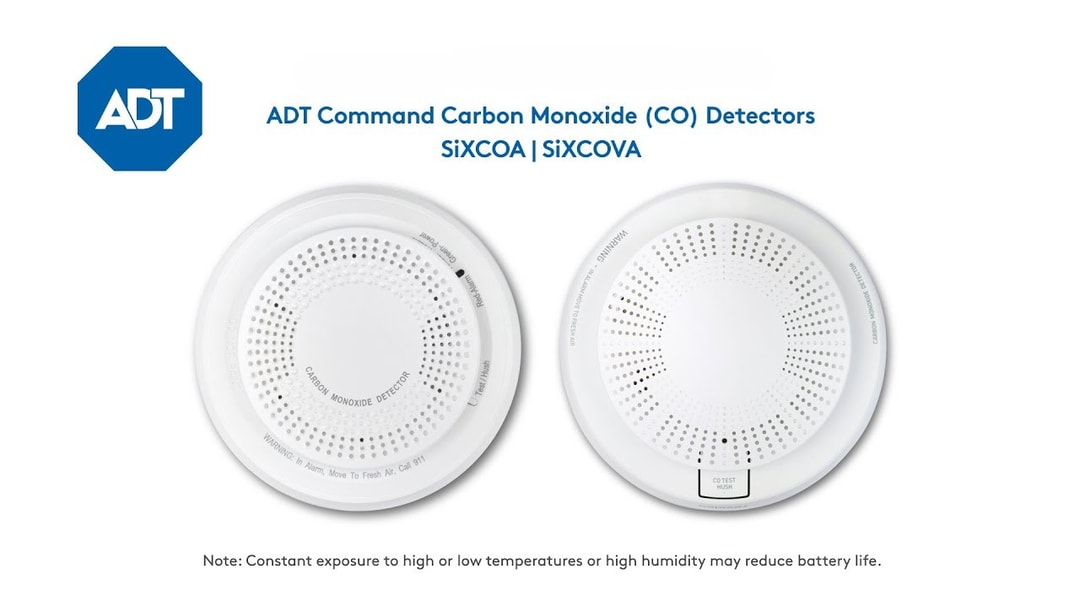
ADT CO Detector
Electrochemical CO sensing that reports to the ADT monitoring center within seconds of an alarm, not just to whoever is home to hear it.
View full specsFrequently Asked Questions
What do I do if my carbon monoxide detector goes off?
If your CO detector sounds its emergency alarm (4 beeps, pause, 4 beeps repeating), evacuate everyone including pets immediately. Do not stop for belongings. Leave a door open as you exit. Call 911 from outside the home. Do not reenter until the fire department has measured CO levels and officially cleared the space. Seek medical attention for anyone with symptoms such as headache, dizziness, or nausea.
Does carbon monoxide rise to the ceiling or stay low?
Carbon monoxide does not significantly rise or fall. Its molecular weight is 28 g/mol, nearly identical to air at 29 g/mol, so it distributes evenly throughout a room at all heights. This is different from natural gas, which rises, and propane, which sinks. Mount CO detectors at breathing height, approximately 5 feet from the floor, not on the ceiling or floor.
How do I know if my carbon monoxide alarm went off for real or because of a low battery?
Count the beep pattern. A real CO detection alarm produces 4 continuous beeps, then a pause, then 4 more beeps, repeating without stopping. This requires immediate evacuation. A low battery produces a single short chirp approximately once per minute and does not repeat in a rapid 4-beep sequence. End of life produces 5 chirps per minute. If you are uncertain about the pattern, evacuate and call 911 to be safe.
Can you reset a carbon monoxide detector?
Yes. Press and hold the test/reset button for 5 seconds. The unit will beep and reset. However, if CO was genuinely detected, do not reset the alarm and reenter the home until the fire department has cleared the space and you have identified and fixed the source. Resetting a still-active CO situation eliminates your warning and puts your household at risk. Only reset after the source is resolved and the space has been ventilated.
What causes false carbon monoxide alarms?
Common causes of false CO alarms include: a detector placed too close to gas appliances or exhaust vents (which expose the sensor to normal combustion byproducts), a detector past its 5 to 7 year service life with a degraded electrochemical sensor, high humidity causing condensation inside the sensor, low battery voltage causing erratic readings, and paint fumes or cleaning solvents in an enclosed space. If your detector alarms frequently without symptoms, check its age and location before assuming it is faulty.
How many carbon monoxide detectors do I need in my home?
The NFPA recommends at least one CO detector on every level of the home and outside each sleeping area. For a two-story home with sleeping on the second floor, that means a minimum of two detectors: one on the main level and one in the hallway outside the bedrooms. Homes with gas appliances, attached garages, or fuel-burning heating systems benefit from additional detectors near those specific risk points. Place each unit at breathing height, approximately 5 feet from the floor.
Sources
- 1. CDC Carbon Monoxide Fact Sheet : approximately 400 Americans die annually from unintentional non-fire CO poisoning
- 2. NFPA : NFPA 720: Standard for the Installation of Carbon Monoxide Detection and Warning Equipment
- 3. CPSC : Carbon Monoxide Safety guidance: approximately 20,000 emergency room visits per year
- 4. UL 2034: Standard for Single and Multiple Station Carbon Monoxide Alarms (defines alarm beep patterns and sensor lifespan requirements)
Get CO Protection That Acts Without You
NetSecure360 is an authorized ADT dealer. We offer ADT-powered CO and fire monitoring systems that automatically dispatch emergency services when an alarm triggers, whether your family is awake, asleep, or away from home.